Come From Away: The Complete Musical & Audition Guide
Come From Away is one of our favorite musicals. Not only did we get the chance to catch the show on Broadway, but in early 2026, Daniel and I got the chance to play Claude and Beverley in one of the very first community theatre productions!
The show seems deceptively simple: twelve actors, a handful of chairs and tables, everyday clothes, and a runtime of only about 100 minutes. But performing it is no small task! Come From Away demands strong actors and singers, precise ensemble work, fast character changes, and a variety of dialects, with minimal offstage time.
And then there’s the chairs…so many chairs. Remembering when to move which chair was much harder than memorizing our lines!
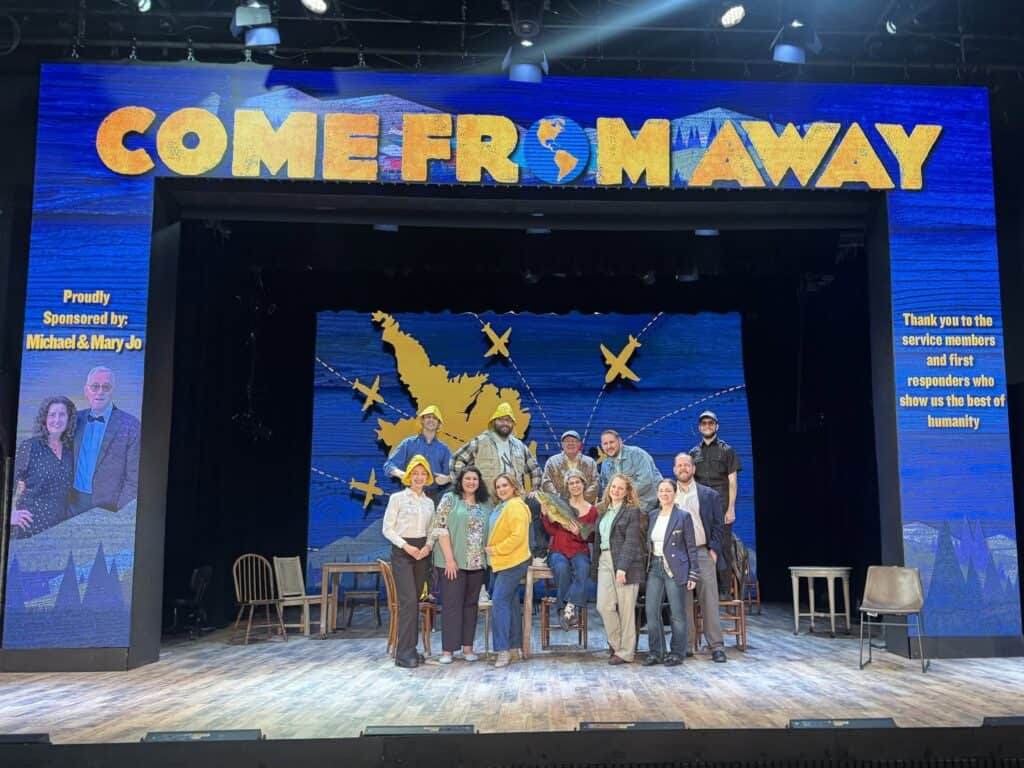
Whether you’re considering auditioning for Come From Away, already preparing for callbacks, or trying to decide whether your theatre should produce it, this guide covers the characters, songs, casting, audition requirements, and production challenges you’ll want to know.
Come From Away at a Glance
| Writers | Irene Sankoff and David Hein |
| Book, music, & lyrics | Irene Sankoff and David Hein |
| Broadway opening | March 12, 2017 |
| Setting | Gander, Newfoundland, and surrounding communities, September 2001 |
| Based on | True events following the September 11 attacks |
| Running time | About 100 minutes |
| Intermission | None |
| Original cast size | 12 performers |
| Expanded casting | Permitted |
| Structure | One act |
| Rating | PG |
| Musical style | Contemporary musical theatre with Newfoundland/Celtic folk influences |
| Dance level | Little traditional dance; significant staged movement |
| Licensing | Music Theatre International in the U.S. and Canada |
The original production uses six male and six female actor tracks, with every performer playing multiple characters. MTI now specifically permits licensed theatres to expand the cast, separate some roles, and add townspeople, passengers, and air traffic controllers.
The Broadway production ran from 2017 through 2022 for 1,669 performances and received seven Tony nominations, winning Christopher Ashley the Tony Award for Best Direction of a Musical.
What Is Come From Away About?
Come From Away tells the true story of what happened in and around Gander, Newfoundland, after U.S. airspace was closed on September 11, 2001.
Thirty-eight planes carrying more than 6,500 passengers and crew were diverted to Gander International Airport. The sudden arrivals dramatically increased the population of the small community, and local residents scrambled to provide food, shelter, clothing, medicine, transportation, and anything else their unexpected guests needed.
But the show isn’t primarily about the terrorist attacks themselves. In fact, rather than being a “9/11 musical,” it has been referred to as a “September 12th musical.” Its focus is what happened afterward: strangers from around the world finding themselves trapped together during an unimaginably frightening few days, and the Newfoundlanders who simply got to work helping them.
That distinction is important for performers. Come From Away certainly contains grief, fear, and trauma, but it is also extremely funny, warm, and energetic.
Come From Away Synopsis
The show opens as the people of Newfoundland introduce their home and their daily lives. In Gander, September 11 begins like any other day—until news arrives that American airspace has been closed and commercial flights are being diverted to Canada.
Gander International Airport, once an important refueling stop for transatlantic aviation, suddenly receives 38 planes carrying thousands of people.
For hours, passengers remain aboard the planes without fully understanding what has happened. Among them are American Airlines Captain Beverley Bass; Diane, a woman from Texas worried about her son; Nick, an English businessman; Hannah, whose son is a firefighter in New York; a gay couple both named Kevin; and travelers from dozens of other countries.
Meanwhile, the people of Gander and the neighboring communities mobilize.
Schools, churches, community centers, and other buildings become shelters. Residents collect bedding, clothes, toiletries, and food. Bus drivers transport passengers despite an ongoing strike. Bonnie, who runs the local SPCA, becomes increasingly concerned about animals still trapped aboard the planes.
When the passengers are finally allowed to disembark, the townspeople welcome them—although the shock of the attacks, language barriers, and cultural differences make the first interactions uneasy.
Over the next several days, those barriers begin to break down.
Diane and Nick develop an unexpected romantic connection. Hannah desperately waits for news about her firefighter son. Beverley reflects on a lifetime spent breaking barriers as a female pilot and on suddenly seeing the profession she loves associated with destruction. Kevin T. enjoys the growing sense of community while his boyfriend, Kevin J., remains nervous about revealing that they are gay. Ali, a Muslim passenger, encounters suspicion and prejudice in the aftermath of the attacks.
The Newfoundlanders continue feeding, housing, and supporting thousands of strangers, eventually inviting their guests to the local bar and initiating some of them as honorary Newfoundlanders in a traditional screech-in ceremony.
Eventually American airspace reopens and the passengers leave. Their return home, however, is not a simple happy ending. Some discover people they love have died. Relationships have changed. The world they return to is not the one they left.
Ten years later, many of the passengers return to Newfoundland and reunite with the people who helped them. What began as several terrifying days in September has created relationships that lasted far beyond them.
Come From Away Characters and Casting
The first thing to understand before auditioning is that Come From Away doesn’t really have twelve conventional “roles.”
It has twelve actor tracks.
Each performer has a primary character but also plays several secondary characters, along with passengers, townspeople, and others. In the original casting structure, changing a jacket, hat, posture, voice, or dialect may be all that separates one character from the next.
Female Tracks
| Track | Primary Character | Vocal Type | Playing Age |
| Diane | American passenger who develops a relationship with Nick | Contemporary soprano | 50s–60s |
| Hannah | Mother desperately trying to reach her firefighter son | Contemporary soprano with strong belt/mix | 40s–60s |
| Janice | Young local television reporter | Contemporary soprano with belt/mix | 20s |
| Beulah | Warm, capable Gander resident who befriends Hannah | Mezzo/belt | 40s–60s |
| Bonnie | SPCA worker determined to rescue stranded animals | Mezzo/belt | 30s–40s |
| Beverley / Annette | Trailblazing female pilot / local teacher with penchant for romantic fantasies | Strong contemporary mezzo | 40s–50s |
Male Tracks
| Track | Primary Character | Vocal Type | Playing Age |
| Oz | Gander police constable | Contemporary tenor | 30s–50s |
| Kevin T. / Garth | Kevin J.’s boyfriend & boss / local union leader | Contemporary tenor | 30s–40s |
| Kevin J. / Ali | Kevin T.’s boyfriend / Muslim passenger Ali | Tenor or baritenor | 30s–40s |
| Bob | Initially wary New Yorker | Baritone | 20s–40s |
| Claude | Mayor of Gander | Baritone with strong upper range | 40s–60s |
| Nick / Doug | English passenger Nick / Newfoundland air traffic controller Doug | Baritone or baritenor | 50s–60s |
Which Roles Are the Leads in Come From Away?
This is one show where “lead” and “supporting” aren’t especially useful labels.
Beverley gets the show’s most recognizable solo. Hannah has one of its biggest emotional moments. Diane and Nick carry an ongoing romantic storyline. Claude frequently acts as the voice of Gander. But nobody disappears backstage while another actor carries twenty minutes of the show.
It is a true ensemble piece. The actors who thrive in Come From Away tend to enjoy being part of a team of storytellers.
Come From Away Song List
One unusual feature of Come From Away is how little of the score functions like a traditional collection of standalone Broadway songs. Music, dialogue, narration, and underscoring flow into one another constantly.
The licensed score includes:
| Song | Main Focus |
| Welcome to the Rock | Company introduction to Newfoundland and the story |
| 38 Planes | The planes begin arriving in Gander |
| Blankets and Bedding | Townspeople prepare for thousands of guests |
| 28 Hours / Wherever We Are | Passengers’ experience of being stranded |
| Darkness and Trees | Fear and confusion as the passengers are moved into an unfamiliar place |
| On the Bus | Passengers finally leave the planes and travel into the community |
| Darkness and Trees (Reprise) | The uncertainty of the passengers’ arrival continues |
| Lead Us Out of the Night | Passengers learn about the events of the attacks |
| Phoning Home | Passengers attempt to contact loved ones |
| Costume Party | Passengers begin adapting to their situation |
| I Am Here | Hannah emotionally attempts to get any information about her firefighter son |
| Prayer | Different faith traditions respond to the crisis |
| On the Edge | Fear and uncertainty intensify |
| In the Bar / Heave Away | Passengers and locals let loose and begin celebrating together |
| Screech In | Visitors become honorary Newfoundlanders |
| Me and the Sky | Beverley tells the story of her career in aviation |
| Stop the World | Nick and Diane’s relationship develops |
| Somewhere in the Middle of Nowhere | The passengers prepare to leave |
| Something’s Missing | The travelers confront the changed world at home |
| Finale | Passengers and townspeople reunite in Newfoundland years later |
What Are the Best-Known Songs From Come From Away?
“Me and the Sky” is by far the most conventional solo in the score and has become the show’s signature audition and concert song.
“Stop the World” is the closest thing to a traditional romantic duet.
But numbers like “Welcome to the Rock,” “Screech In,” “Prayer,” and “38 Planes” arguably tell you more about the musical itself. This is an ensemble-driven score in which individual voices continually emerge from and return to the group.
The music draws heavily from Newfoundland’s folk traditions, themselves influenced by Irish, Scottish, English, and French music. The score incorporates instruments including fiddle, bodhrán, whistles, mandolin, bouzouki, and even the traditional Newfoundland “ugly stick.”
Need an audition song for Come From Away?
Get some divine help. See our picks for every major character or track, or let the Audition Song Finder match you with songs based on your role, voice, age, and style.
What Is Come From Away Like to Perform?
Here’s where Come From Away is harder than it looks.
You barely leave the stage.
This is not a show where you perform your scene and relax backstage for twenty minutes. The original twelve performers collectively carry virtually the entire show for about 100 minutes without intermission.
Character changes happen constantly.
You might switch nationality, accent, physicality, age, personality, and costume pieces within seconds. And those changes have to be immediately understandable to the audience.
The ensemble has to be extremely precise.
There may not be much in the way of conventional musical-theatre dance—MTI actually lists the show’s dance requirement as “none”—but that doesn’t mean performers simply stand around singing.
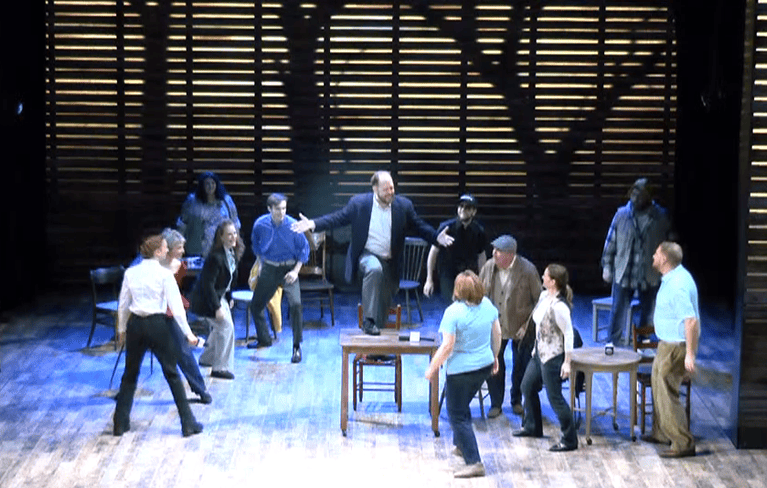
The storytelling relies on tightly coordinated movement, transitions, and set movement (done by the actors). The original production became known for creating an enormous number of locations and situations from twelve actors, fourteen chairs, and three tables.
The acting has to feel natural.
This is especially important, because almost all of the characters are people who actually existed.
Broad character choices have their place—Annette can be very funny with her fantasy sequences, for example—but the overall acting style works best when it feels human rather than “musical-theatre big.”
Everyone is telling the story.
Characters frequently address the audience directly and move between participating in events and narrating them.
For that reason, storytelling ability may matter as much as conventional acting ability in casting this show.
Auditioning for Come From Away
If you’re preparing for a Come From Away audition, your goal isn’t simply to prove that you can sing the highest or loudest. The creative team needs actors who can help carry an ensemble.
Show that you can tell a story.
This may be the single most important audition principle for Come From Away. Choose material where something happens. You should be able to establish a person, situation, and point of view quickly.
Don’t over-sing it.
There are certainly demanding vocals in the show and the ensemble needs excellent musicianship. But much of the score favors natural contemporary voices rather than stereotypically polished Broadway singing. Even MTI’s official character descriptions repeatedly use words like “warm” and “natural” when describing the desired vocal quality.
Comedy is valuable.
People sometimes remember the emotional ending and forget just how funny Come From Away is. Claude, Oz, Bob, Janice, Bonnie, Annette, both Kevins, and many of the smaller characters offer significant comedy. If you’re good at grounded character comedy, let them see it.
Be ready for accents.
The Newfoundlanders and Plane People need to sound distinctly different, and several tracks require additional accents as actors change roles.
That doesn’t necessarily mean you need a flawless Newfoundland dialect walking into an open community-theatre audition unless the audition notice specifically asks for one. But if dialect material is provided, take it seriously.
Some professional productions explicitly request Newfoundland dialect work during auditions, which illustrates how central vocal characterization can be to casting the show.
Be willing to play.
You may be asked to switch characters, change physicality, try different voices, or make a completely different acting choice. The director needs to know whether you can transform quickly and portray a variety of characters.
Choose an audition song that fits the world of the show.
For most roles, look for contemporary musical-theatre material with:
- strong storytelling
- a conversational quality
- warmth or character
- some folk, pop, or rock influence where appropriate
- an age and personality that make sense for the track
You don’t need to find something that sounds exactly like Newfoundland folk music. And unless specifically requested, I wouldn’t audition with “Me and the Sky” or a different song from the show.
But do consider songs with a Celtic feel and/or emotional substance similar to what your target role is experiencing.
Producing Come From Away in Community Theatre
On paper, Come From Away can look like a relatively easy show to produce.
Small cast. Contemporary costumes. Minimal scenery. No huge dance chorus.
Some of that is true. But the show’s difficulty is concentrated in other places.
Cast
You need 12 extremely dependable actor-singers if you’re using the original structure. There is very little room to hide a weak link.
The good news for community theatres is that expanded casting is now officially permitted. Individual characters can be separated, and additional passengers, townspeople, and air traffic controllers can be added. That can make Come From Away much more practical for organizations that want to involve a larger company.
However, I wouldn’t expand the cast simply because you can. The intimacy and constant transformation of the original twelve-person structure are a major part of what makes the show special.
Set
You do not need to reproduce the Broadway set design, nor the rotating stage! The original staging famously creates buses, planes, community centers, bars, and other locations primarily through chairs, tables, lighting, and actor movement. That makes the show unusually adaptable to different spaces and budgets.
Regional and community productions have gotten very creative, experimenting with more elaborate, realistic set designs, and these can be very effective as well.
What you do need is a scenic concept that allows extremely fast transitions. Building a full-scale airplane that takes ninety seconds to move onstage would work against the way this show tells its story.
Costumes
The base costumes are largely contemporary clothes appropriate to 2001. The bigger challenge is character differentiation.
Actors need to transform between roles quickly, often using a small costume piece such as a jacket, hat, or accessory. The Broadway costume design intentionally used minimal additions to signal those changes.
For community theatre, that can mean fewer elaborate costumes—but much more thought about exactly what each piece communicates and how the actors can maneuver them onstage.
Props
There are plenty of small props, but this isn’t generally a prop-heavy show. The bigger challenge is tracking and choreography.
When twelve people are constantly changing characters, moving chairs, handling luggage, drinking, making phone calls, and transforming locations, even simple objects have to appear exactly when they’re needed.
Music
MTI’s standard orchestration calls for seven players covering bass, guitar, mandolin and related instruments, bodhrán/percussion, a second percussion book, whistles/flutes/uilleann pipes, and fiddle. Several books require musicians who can double on a substantial number of specialized instruments.
Finding the right musicians may therefore be considerably harder than finding musicians for a conventional piano-bass-drums musical. And the music matters enormously. Newfoundland music is part of the identity of the show.
That said, a live band is not your only option. MTI also offers an authorized Performance Accompaniment Recording for Come From Away, allowing licensed theatres to perform the full score using pre-recorded tracks played by professional musicians. For theatres that can’t assemble the show’s specialized instrumentation locally, this can make the production considerably more accessible.
Sound
Don’t underestimate sound requirements. This is not a show where you want to discover during tech week that half the cast’s microphones are unreliable.
Twelve performers sing ensemble material, deliver rapid overlapping dialogue with underscoring, and frequently shift between narration and scene work. The audience has to understand the words.
Lighting
Because the physical scenery can remain minimal, lighting does a great deal of storytelling.
A good lighting design helps move the audience instantly between the airplane, bus, school, and bar, while also communicating both raucous group scenes and private emotional moments without stopping the action.
Dialects
Budget rehearsal time for them. The Newfoundland dialect is not simply generic Canadian, Irish, or Scottish. The creators intentionally drew from the actual speech of the people they interviewed, and the difference between Islanders and Plane People is built into the storytelling.
If no one on the production team is confident coaching dialects, bringing in outside help—or at least developing consistent research materials—is worth considering.
Is Come From Away a Good Choice for Community Theatre?
Come From Away can be an excellent community-theatre musical, particularly if your organization has strong adult character actors.
It’s especially well suited to theatres with:
- A deep pool of experienced adult performers
- Strong ensemble singers
- Actors comfortable with accents and character work
- An ensemble-first company culture
- Strong musicians
- Good sound capabilities
- Limited scenic budgets but creative directors and designers
- Audiences interested in meaningful contemporary musicals
It may be challenging if:
- Most of your available performers are very young
- Actors primarily want conventional starring roles
- You struggle to find strong male performers
- Specialized musicians are difficult to find locally
- Rehearsal time is limited
- Your company has difficulty with precision ensemble staging
Come From Away succeeds when the company feels like one ensemble telling many people’s stories, not a collection of featured performers waiting for their turns.

Come From Away looks simple because good productions make an enormous amount of complicated work invisible.
It doesn’t require a giant set, huge chorus, elaborate dance vocabulary, or dozens of costume changes. Instead, it asks twelve—or potentially more—actors to create an entire community and thousands of stranded travelers through precise storytelling, music, movement, and imagination.
For auditionees, that means acting, versatility, and ensemble instincts matter at least as much as vocal fireworks.
For community theatres, it means the show’s modest physical scale shouldn’t be mistaken for an easy production.
Get the right actors and a creative team that understands the rhythm of the storytelling, and Come From Away offers something community theatre is uniquely equipped to celebrate: ordinary people coming together to take care of one another.