Legally Blonde: The Complete Musical & Audition Guide
Legally Blonde can look like pure pink, high-energy fun—and it absolutely is fun—but the musical works because there is much more going on underneath the surface. It is a contemporary pop-rock comedy, a demanding female star vehicle, a dance-heavy ensemble show, and a surprisingly sincere story about a young woman learning to trust her own intelligence instead of letting other people define her.
A strong production needs an Elle who can carry nearly the entire evening without losing vocal or comic energy, an ensemble that can sing and move with enthusiasm, and supporting actors who know how to play heightened comedy without turning the characters into cartoons.

I have not yet had the pleasure of performing in this one, but it’s at the top of my list. I have, however, performed the song Ireland in revues and (casting directors, take note) I would LOVE to play Paulette someday. 👋
Whether you are auditioning for Elle, Emmett, Paulette, Callahan, one of the Delta Nus, or the ensemble—or deciding whether Legally Blonde is the right choice for your community theatre—this guide covers the characters, songs, casting, audition priorities, and production demands that matter most.
Have you performed in Legally Blonde?
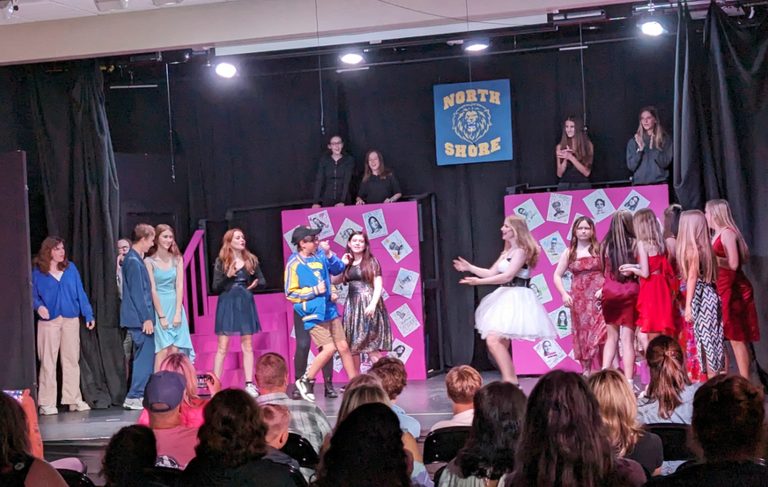
We’d love to feature photos from community theatre productions in our Show Guides. Send us a favorite production photo, along with your theatre name and photographer credit, for a chance to be featured on Audition Angel!
Legally Blonde at a Glance
| Book | Heather Hach |
| Music and lyrics | Laurence O’Keefe and Nell Benjamin |
| Based on | Amanda Brown’s novel and the MGM film |
| Broadway opening | April 29, 2007 |
| Original Broadway run | Palace Theatre; 595 performances after 30 previews |
| Setting | Southern California and Harvard Law School in Cambridge, Massachusetts |
| Structure / rating | Two acts; MTI rating: PG-13 |
| Cast size | Flexible; works well with a medium (11–20) or large (21+) company |
| Principal casting | 7 principal roles plus ensemble, with many named featured parts |
| Musical style | Contemporary Broadway / pop-rock with comic character songs and power-ballad writing |
| Dance / movement | Dance-heavy; several major song-and-dance numbers and substantial ensemble choreography |
| U.S. licensing | Music Theatre International (MTI) |
| Music resources | Standard orchestration plus MTI resources including KeyboardTEK, OrchExtra, performance tracks, and RehearScore |
What Is Legally Blonde About?
Legally Blonde follows Elle Woods, a fashionable and relentlessly optimistic sorority president whose boyfriend, Warner Huntington III, breaks up with her because he wants a more “serious” future. Warner heads to Harvard Law School, and Elle decides the obvious solution is to get into Harvard herself and win him back.
That premise sets up a broad comedy, but the musical gradually changes the question. Elle begins by trying to become the kind of woman Warner thinks belongs in his world. By the end, she has discovered that she is a strong, capable woman with much bigger prospects, as long as she refuses to abandon the qualities that make her herself.
Legally Blonde Synopsis
At UCLA, Elle Woods and her Delta Nu sorority sisters are convinced that Elle’s longtime boyfriend, Warner Huntington III, is about to propose. Instead, Warner tells Elle that he needs someone more serious if he is going to build the prestigious future he imagines for himself. He leaves for Harvard Law School, and a devastated Elle decides to follow him.
With help from her sorority sisters, family, and a very unconventional admissions presentation, she earns her own place at Harvard. Once she arrives in Cambridge, however, the social rules have changed. Warner has reunited with Vivienne Kensington, an intelligent, ambitious law student who fits much more neatly into his idea of a suitable partner. Professor Callahan, one of Harvard’s most formidable law professors, immediately establishes a competitive atmosphere in which students are expected to fight for his approval.
Elle struggles at first. Her classmates underestimate her, Vivienne is openly hostile, and Elle is still focused on Warner instead of the opportunity in front of her. Emmett Forrest, Callahan’s teaching assistant and a student who has worked hard for every advantage he has, pushes Elle to stop coasting on charm and prove that she belongs. With the Delta Nus appearing in her imagination as a Greek chorus, Elle begins applying herself seriously.
Her work pays off. Elle earns one of the coveted internships on Callahan’s team, along with Warner, Vivienne, and several classmates. The firm is defending Brooke Wyndham, a famous fitness entrepreneur accused of murdering her wealthy older husband. Brooke refuses to reveal her alibi, even though doing so could save her case.
Elle recognizes Brooke as a fellow Delta Nu and earns her trust. Brooke privately admits that she was having liposuction at the time of the murder, an alibi that could damage her fitness empire if it became public. Elle promises to keep the secret. When the rest of the legal team pressures her to reveal it, Elle refuses.
Meanwhile, Elle’s friendship with Paulette, a warm but insecure hairstylist, gives both women someone who sees their potential. Paulette dreams of a better romantic life and becomes interested in Kyle, a UPS delivery man. Elle also helps Emmett recognize that presentation and confidence can affect how other people see him, even as Emmett increasingly appreciates Elle for qualities Warner never valued.
The murder trial gives Elle a chance to use observation, intuition, and legal reasoning together. She helps expose a key witness’s hidden relationship, and the defense begins gaining ground. But after a successful day in court, Callahan propositions and kisses Elle. Elle rejects him, and he fires her. Humiliated and convinced that she was never taken seriously, she prepares to leave Harvard.
Vivienne, who witnesses what happened, becomes the person who challenges Elle to stay. Their rivalry finally gives way to respect. With support from Emmett, Paulette, her friends, and her classmates, Elle returns to the case. Brooke fires Callahan and puts her trust in Elle.
In the courtroom, Elle notices a detail involving hair care that undermines Chutney Wyndham’s story about where she was when her father was killed. Under questioning, Chutney breaks down and reveals the truth. Brooke is cleared, and Elle proves that the knowledge and instincts other people mocked are exactly what allow her to solve the case.
By graduation, Elle no longer needs Warner’s approval. Her relationships with Vivienne, Paulette, Emmett, and the people around her are built on mutual respect rather than status. She has found a career she genuinely wants, a community that values her, and a much clearer sense of who she is.
Legally Blonde Characters and Casting
The full version is centered on seven principal characters, but community theatres should think beyond those seven when planning auditions. Margot, Serena, Pilar, Enid, Kyle, Nikos, Carlos, Chutney, Elle’s parents, Harvard students, salon customers, and several other named parts create a large number of featured opportunities. Many of those roles are commonly drawn from or doubled within the ensemble.
Principal Roles
| Character | Role description | Vocal / movement | Playing age |
|---|---|---|---|
| Elle Woods | Driven, optimistic sorority president who follows Warner to Harvard and discovers her own ambitions. | Mezzo-soprano / soprano belter, F#3–F5; heavy dance and sustained movement; exceptional stamina | 18–25 |
| Emmett Forrest | Hardworking law student and teaching assistant who becomes Elle’s mentor, ally, and love interest. | Tenor / high baritone, A2–A4; light-to-moderate movement | 20–25 |
| Paulette | Warm, outspoken salon owner who becomes Elle’s closest friend. | Mezzo / alto belter, G3–A5; moderate movement and featured comic choreography | 35–45 |
| Professor Callahan | Powerful, predatory law professor and managing partner who controls the internship. | Baritone, A2–F#4; light movement | 45–55 |
| Warner Huntington III | Status-conscious ex-boyfriend whose rejection sets Elle’s journey in motion. | Tenor / high baritone, A2–G#4; moderate ensemble movement | 20–25 |
| Vivienne Kensington | Accomplished Harvard student and romantic rival who later becomes a crucial ally. | Soprano / high belter, A3–Ab5; moderate dance/movement | 20–25 |
| Brooke Wyndham | High-profile fitness entrepreneur and murder defendant who entrusts Elle with her alibi. | Mezzo / soprano belter, A3–G5; highly athletic choreography, including jump-rope work | 25–35 |
Featured Roles and Ensemble
| Character / track | Role description | Vocal / movement | Playing age |
|---|---|---|---|
| Margot, Serena, and Pilar | Elle’s closest Delta Nu friends and the Greek Chorus in her imagination. | Strong contemporary pop vocals; strong movement/dance | 18–25 |
| Enid Hoopes | Outspoken Harvard classmate and fellow intern. | Contemporary ensemble vocals; moderate movement | Young adult |
| Kyle / Dewey / Grandmaster Chad | Three distinct comic roles commonly doubled by one actor. | Character singing; moderate movement; brief rap/high tenor material varies by track | Adult; flexible |
| Nikos / Carlos | Featured courtroom characters at the center of the trial’s comic turning point. | Character tenor vocals; featured comic movement | Young adult |
| Kate, Chutney, Judge, Elle’s parents, admissions panel, Aaron/Sundeep, and more | Named supporting and comic roles, commonly assigned within the ensemble. | Varies by assignment; many also sing and move with the ensemble | Varies by role |
| Ensemble | Company members who populate Delta Nu, Harvard, the salon, the courtroom, and the show’s other worlds. | Strong contemporary pop-rock vocals; substantial dance/movement | College age–adult; flexible |
Which Roles Are the Leads in Legally Blonde?
Elle Woods is unquestionably the lead. This is a genuine star vehicle: she drives nearly every major story beat, sings throughout both acts, participates in substantial choreography, and must carry both the biggest comedy and the emotional transformation.
Emmett, Paulette, Callahan, Warner, Vivienne, and Brooke are best understood as major supporting roles rather than co-leads. Emmett has the most sustained relationship with Elle and a substantial arc; Paulette has major comic and vocal material; Callahan drives the legal conflict; Vivienne becomes crucial late in the story; Warner motivates the opening action; and Brooke has one of the show’s most demanding featured numbers. The ensemble is also unusually important because the style and energy of Legally Blonde depend on a company that can make every world—from Delta Nu to Harvard to the courtroom—feel fully alive.
Legally Blonde Song List
The principal musical numbers are listed below in show order. Productions may also include brief underscoring and transitional material not listed here.
| Song | Featured performers | Description |
|---|---|---|
| Omigod You Guys! | Margot, Serena, Pilar, Elle, Delta Nus | The Delta Nus prepare Elle for the proposal they expect, introducing the show’s glossy sorority world. |
| Serious | Warner, Elle | Warner breaks up with Elle because she does not fit the future he has planned for himself. |
| Daughter of Delta Nu | Margot, Serena, Pilar, Kate, Delta Nus | Elle’s friends rally around her after the breakup and help spark her plan to follow Warner to Harvard. |
| What You Want | Elle and company | Elle turns her Harvard application into a full-scale campaign and wins over the admissions committee. |
| Harvard Variations | Emmett, Harvard students | Emmett introduces Elle to her ambitious classmates and the competitive culture of Harvard Law. |
| Blood in the Water | Callahan and company | Callahan teaches his students that winning—not fairness—is what matters in his courtroom. |
| Positive | Elle, Delta Nu Greek Chorus | The Delta Nus try to rebuild Elle’s confidence after she learns Warner is dating Vivienne. |
| Ireland | Paulette | Paulette comforts Elle with an unexpectedly heartfelt fantasy about Ireland and the life she wishes she had. |
| Ireland (reprise) | Paulette | A quick return to Paulette’s Irish fantasy as her romantic prospects begin to look brighter. |
| Serious (reprise) | Warner, Elle | Warner and Elle reflect on their relationship. |
| Chip on My Shoulder | Emmett, Elle, company | Emmett challenges Elle to stop chasing Warner’s approval and put in the work, leading into her academic transformation. |
| So Much Better | Elle and company | Elle celebrates earning a coveted internship—and realizes Warner is no longer the measure of her success. |
| Whipped into Shape | Brooke, Callahan, company | The legal team reviews Brooke’s workout video, then heads to the prison where she leads an inmate workout. |
| Take It Like a Man | Elle, Emmett, salespeople | Elle gives Emmett a makeover for the internship, and their growing affection becomes harder to miss. |
| Bend and Snap | Serena, Paulette, Elle, Delta Nus, salon workers | Serena, Elle, and the Delta Nu Greek Chorus teach Paulette and the salon crowd their signature move in hopes of catching Kyle’s attention. |
| There! Right There! | Nikos and trial company | The courtroom gets sidetracked by competing assumptions about Nikos, a key witness. |
| Legally Blonde | Elle, Emmett | After Callahan’s advances, Elle prepares to leave Harvard while Emmett asks her not to give up on herself. |
| Legally Blonde (Remix) | Vivienne, Enid, Elle, company | Vivienne rallies Elle back to the case, and the company joins her return to the courtroom. |
| Omigod You Guys! (reprise) | Elle and company | A short company reprise that carries the story toward graduation. |
| Find My Way/Finale | Elle, Paulette, company | The finale jumps ahead to graduation and reveals where Elle, Paulette, and the rest of the company land. |
Need an audition song for Legally Blonde?
Get some divine help. See our picks for every major character or track, or let the Audition Song Finder match you with songs based on your role, voice, age, and style.
What Is Legally Blonde Like to Perform?
Legally Blonde is demanding, but it should appear effortless. Performers need the stamina to sing and move at the show’s pace and the acting instincts to ground its broad comedy. Overall, both the performers and the audience should be having lots of fun!
- Elle has to pace herself. She is rarely offstage, so she cannot sing or play every moment at full power.
- The ensemble never gets to coast. The company is constantly singing, dancing, changing characters, and shifting between sharply different worlds.
- Contemporary singing still has to tell the story. Belt and mix matter, but so do rhythmic phrasing, clear lyrics, and quieter emotional turns.
- Comedy has to stay human. The jokes work best when the characters take their own problems seriously.
Auditioning for Legally Blonde
An audition for Legally Blonde should show more than a big contemporary voice. The room needs to see someone who can land a joke, make clear acting choices, move with confidence, and keep the story going at the show’s speed.
- Show personality without doing an imitation. Bring your own point of view instead of recreating a Broadway or film performance.
- Sing the thought, not just the style. Choose material with a clear want and action, then let the lyrics sound like thoughts rather than a polished recitation.
- Be ready to move. At a dance call, learn cleanly, commit, and smile through any mistakes.
- Choose an audition song that fits the world of the show. Contemporary musical theatre or pop-rock should sit comfortably in your voice and show the casting team that you have both the vocal power and the acting ability to shine in this show. Nearly every female lead in this show belts, so our audition songs for belters are a great place to start, and Paulette hopefuls should also look at our picks for altos.
Producing Legally Blonde in Community Theatre
The title is familiar, but the show is not easy to produce. You need a terrific Elle, a cast that can sing pop-rock and dance well, and enough rehearsal time to make the whole thing look fast and effortless.
Cast
Cast Elle first and cast her carefully. She is almost never offstage, and the role demands big singing, dancing, comedy, and real emotional range. The supporting roles need confident comic actors, and the ensemble needs to sing and move well. A bigger cast is only helpful if you can rehearse everyone enough to keep the group numbers sharp.
Staging and Design
Keep the scenery flexible. The show jumps from Delta Nu to Harvard, the salon, a department store, a jail, and a courtroom, so pieces that can change purpose quickly will work better than a separate set for every location. Costumes and lighting can do much of the work of establishing each world.
Plan costume changes early. Many ensemble members play several parts, and shoes, wigs, props, and microphones all have to move backstage without slowing the show down. Decide early whether Bruiser and Rufus will be played by live dogs and, if so, leave time for training.
Music and Sound
The score needs strong pop-rock singers and a band (or licensed backing tracks) that can keep the energy up without overpowering the cast. If you are not using the full orchestration, check the options available with your license before settling on a plan.
Clear sound matters as much as volume. A lot of the comedy is in the lyrics, and much of the singing happens during choreography. Work out microphone coverage and handoffs well before tech.
Choreography and Movement
The big dance numbers need time. The choreography does not have to copy Broadway or be difficult for the sake of being difficult, but it does need to look confident and clean. MTI also offers Jerry Mitchell’s original Broadway choreography as an optional licensed resource.
Is Legally Blonde a Good Choice for Community Theatre?
Legally Blonde is a great community-theatre title if you have the people to pull it off. It offers a large number of roles, is easy to market, and gives audiences the upbeat comedy they expect. Before choosing it, make sure you have:
- An Elle with the voice, comic timing, and stamina to carry the show
- A strong group of featured performers, especially women
- An ensemble that can sing and move with confidence
- A choreographer who can stage large production numbers
- Enough rehearsal time and sound support for a busy contemporary musical
If those pieces are in place, the show can be a terrific fit. If they are not, the title alone will not carry the production.

Legally Blonde works because it delivers the bright, funny, high-energy show audiences expect while giving Elle a genuinely satisfying journey. It’s about ambition, friendship, and learning that you don’t have to make yourself smaller or become someone else to be taken seriously. The pink, preppy energy, the dogs, and the big production numbers make it fun; Elle’s growth is what gives the show its heart.