Your First Community Theatre Audition: What to Expect and How to Prepare
So you found an audition for a local show. You’d love to try out, but you’ve never done this before! Maybe performing has always been a dream of yours, or perhaps you’re trying out something new on a whim. Luckily, you’ve found your way to Audition Angel — the site that will teach you everything you need to know about getting started!

You don’t need years of experience (or any experience!) to audition for community theatre. You do need to find out how to prepare for this particular audition. If you’re new to the world of cold reads, headshots, and 32 bars, you’re in the right place! Read on to learn how to prepare and feel confident walking into your first audition!
Quick guide: What are theatre auditions usually like?
Auditions come in many varieties, and I’ve probably been to every type! But, this is what I’ve found to be most common.
For musicals:
- You will usually sing in a rehearsal room or onstage for the casting team, on your own. But it’s also common to sing in front of the entire group of auditionees.
- Some theatres use a live pianist; others ask you to sing with a backing track. Check the audition notice so you bring the right thing.
- You may be asked to prepare a short monologue.
- Sometimes you will also read scenes and/or dance, but sometimes those are reserved for callbacks.
For plays:
- Most commonly, auditionees stay in one big group and take turns reading scenes from the script. A “cold read” is a scene you haven’t rehearsed in advance. You may get a few minutes to look it over, or you may read it immediately.
- It’s also common to be asked to prepare a short monologue to perform for the casting team.
For multiple shows/full season:
- You may be asked to perform 1-2 contrasting song selections and 1-2 contrasting monologues for the casting team. This usually means you’ll do an uptempo song and a ballad, and a comedic and a dramatic monologue.
- Depending on the shows you’re auditioning for, you may also want to pair contemporary selections with classic selections, for both your songs and monologues.
These are just the most common situations. I’ve also been in auditions where we’ve been asked to improv, learn and sing songs from the show, do accents, play theatre games, sing well-known songs in a variety of keys, sing scales, learn and sing harmonies with others, and more. Every audition is unique!
How to prepare for a theatre audition (three steps!)
1. Fully read the audition notice
Before you pick a song or practice a monologue, read the entire audition notice and pull out the details you need:
- When and where: Is it an appointment, an open call, or a choice of audition nights? Is there a separate callback date?
- How to sign up: Do you need to register in advance or can you just show up?
- What to prepare: Does it ask you to prepare a song, monologue, dance combination, or nothing at all? Will the theatre provide scenes to read?
- Music instructions: If you need to sing, how long should the cut be? Is there a pianist, or do you need to bring a backing track? Do they want to hear a song from the show?
- The commitment: What are the rehearsal and performance dates? The casting team will want to know what conflicts you have, so arrive at the audition with this information ready.
If the notice leaves something important out, it’s fine to contact the theatre and ask. Audition requirements vary, and the notice for your show wins over anyone’s general advice, including ours!
2. Get to know the show
Find out what the show is about and who the characters are. If you can, read the script or listen to the cast recording. If there is a proshot (professionally filmed stage production), try to watch it. Movie versions of shows can often be very different from the stage versions, but it can still be helpful to watch the movie, to get added context and understand the style and message of the show.
Pay attention to the parts that interest you, but keep an open mind — the audition team may see you in a role you hadn’t considered. For musicals, get as familiar as you can with the music ahead of the audition date.
3. Prepare your performance material
Music
Your song selection needs to do two things:
- Show off your vocal abilities
- Demonstrate your ability to act while singing, conveying character, story, and emotion.
Choose a song that you could imagine fitting well in the show you’re auditioning for, and ideally, choose something you could imagine your target role singing. Try to match music genre, era, and style, plus a similar kind of character conflict, if possible.
This isn’t the time to try the hardest song you’ve ever sung. Pick something that feels comfortable in your range that you can reliably sing well. Not sure where to start? Our audition song lists for voice types are sorted by style, so you can find something comfortable fast.
If the notice specifies how long your cut should be, make sure to stay within those limits. If it doesn’t, shoot for about one minute of singing. A verse and a chorus plus a strong ending is a good formula.
If there will be a pianist, bring sheet music in your key with a clearly marked start and end. If the theatre asks for a track, follow instructions for how to supply the file. Often you’ll use your phone and connect via a cord or Bluetooth to a speaker, or you may be asked to email your track ahead of time so they can have it ready to play for you.
When you sing, face the casting team and avoid locking eyes with someone at the casting table for the whole song (a very common newbie misstep!). Pick a focal point just beyond the team so they can see your face and be engaged without feeling like they’ve become your scene partner.
Need an audition song?
Get some divine help. See our picks for every major character in the show, or let the Audition Song Finder match you with songs based on your role, voice, age, and style.
Monologue/scenes
Check whether you need a prepared monologue or whether the theatre will supply audition material. For a monologue, honor the time limit and practice speaking to someone specific, even though that person won’t be onstage. Just like with your song, place the other character behind the casting team and face them while you speak.
Choose a monologue that fits the style and era of the show. If it’s a Shakespeare play, choose a classical piece. Contemporary play? Do a contemporary monologue. Choose something comedic for a comedy, dramatic for a drama.
Without getting into a whole acting lesson here, you should try to be “doing” something during your monologue. That doesn’t mean a whole lot of unnecessary movement, but rather, have a goal in mind that you’re trying to achieve. Are you trying to convince someone? Threaten someone? Prove your worth? Release your pain?
For a cold read, you can still prepare by learning the show’s story and practicing reading unfamiliar dialogue aloud from any script you can find. You aren’t expected to know lines you haven’t been given ahead of time, but if you already understand what’s happening in the context of the show, you’ll be worlds ahead of others who didn’t come prepared.
Dance
It’s very rare to be asked to prepare your own dance material for a community theatre audition. Almost always, you will be taught a short dance at the audition (called a combo or combination), practice as a group, and then perform for the casting team in smaller groups.
Wear or bring clothes and shoes you can move in. If the notice asks you to bring a certain type of shoes, like jazz or tap shoes, get those ahead of time and make sure you’re comfortable in them.
If you haven’t been moving regularly, do some light exercise and stretching a few days before the audition, so you don’t hurt yourself! The last dance audition I went to, I hadn’t danced in a while, and boy, was I sore the next day!
What should you wear and bring to a community theatre audition?
We have a two separate posts on this, so check them out to get the full scoop:
Here are some key points:
- Don’t wear a costume. Do wear something that suggests the era and style of the show.
- Lean toward nicer clothes. You don’t need to be fancy, but better to wear a button-down shirt than a ripped tee. This is essentially a job interview.
- Wear or bring something you can dance in, if there is a dance call.
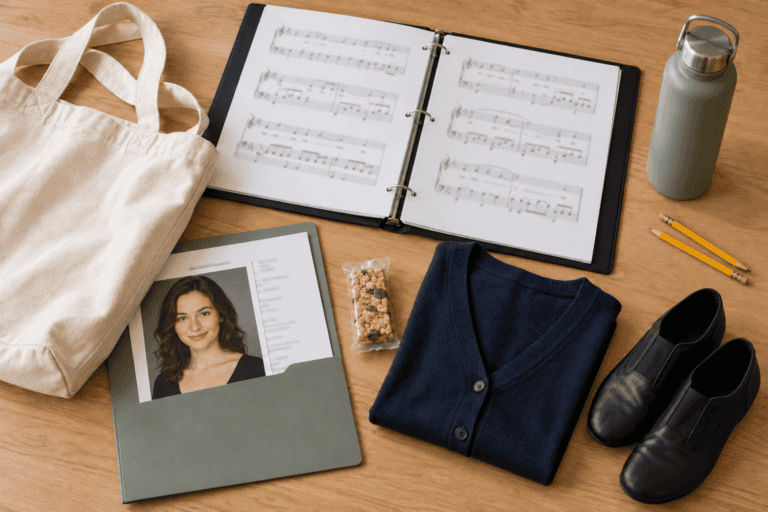
- Bring anything you need for your performance material — sheet music, backing track, dance shoes, etc.
- Have your conflict dates ready to list on your audition form.
- Bring your own pen or pencil so you don’t have to wait to fill out your form if the theatre runs out.
- Ultimately, follow any specific requirements in the audition notice!
Want to be super extra prepared? Toss a clipboard into your bag, in case there’s no good surface to write on. And, if you’re bringing a resume and/or headshot, bring a paperclip to easily attach them to your audition form.
Do you need a resume and headshot for a community theatre audition?
Headshots and resumes are usually not required for community theatre auditions. Often, you will fill out an audition form that asks about your performing experience.
However, it never hurts to have these things! If you do have enough experience to warrant a resume, bringing one can cut down on the time you spend filling out the audition form (you can just write “Please see resume” under the experience section).
A headshot doesn’t have to be professional, especially with today’s mobile phone photography capabilities. Take a nice selfie, crop it closely around your face, and print it out. It can help the casting team remember you when they are considering people for callbacks and casting.
Print your resume on the back of your headshot, or staple the two together, back to back, so they don’t get separated.
Unless the audition notice says that resumes and/or headshots are required, it’s totally up to you whether or not you want to bring one or both.
What happens when you arrive at an audition?
You may check in at a table, fill out a form, get a number, and wait with other performers. In some theatres, everyone auditions in the same room; in others you’ll be called in alone or in a small group. A musical may separate singing, reading, and dancing into different parts of the evening.
Plan to be there for a few hours, especially if the notice doesn’t give an end time. I’ve been to auditions where I was in and out in 10 minutes and others that went on for hours.
The audition form may ask whether you’ll accept an ensemble role or any role. Answer honestly! You don’t have to say yes to a commitment you don’t want, and it’s better to be clear now than to earn a reputation for dropping out of shows. That being said, if you’re brand new to theatre, an ensemble role is a great way to learn and grow!
Performing your song or monologue
When your name or number is called, enter the room and follow any instructions given. They will likely greet you and invite you to share your music with the pianist or connect your device to the speaker.
If you’re singing with a pianist, you’ll give them your music, point out the start and end of your cut, and briefly give the tempo before you move into position. Be nice to the pianist — they are there to be your partner and help you sound good!
We recommend starting by saying hi, introducing yourself, and stating the title of the song you’ll be singing. Simple as this:
Hi! I’m [your full name] and I’ll be singing [title of your song].
If it’s a monologue:
Hi! I’m [your full name] and I’ll be performing a monologue as [character] from [title of play].
Take a moment to get into character by thinking about what has just happened to them to inspire this song or monologue. Then start. Speak loudly and clearly. Use the space effectively (you don’t have to stand still in one spot the whole time).
Performing a cold read of a scene
For a cold read, take a moment to scan the scene. Who are you talking to? What are you trying to get from them? Feel free to ask questions of the team, if the material is new to you.
When it’s time to read, hold the page high enough to be able to see it and keep your head up. Look up when you can, and listen and react to other actors. Move and pantomime if the scene calls for it!
If there is a “reader,” (a member of the team is reading the lines for your scene partner from the casting table), don’t face them. Pretend there’s another actor onstage with you, and say the lines to this imaginary performer, rather than the reader at the table.
If the director asks you to try something a different way, make a new choice and go again. That’s part of the audition, not a sign you got the first version wrong.
You may make a mistake. If you skip a word or get lost temporarily, pick up where you can. Stay in character. Err on the side of performing “big” — it’s much easier to tell an actor to pull back than having to coax them into a stronger performance.
After the audition
The theatre may post a callback list or go straight to casting. They should give you an idea, before you leave the audition, of how you’ll be notified of the results or next steps.
A callback is another chance for the team to see people in particular scenes, songs, or combinations. Some shows don’t hold callbacks at all. If you aren’t called back, don’t treat that as a final decision unless you’re told otherwise.
Once the cast is announced, remember that a production needs people who look and sound right for the roles and with one another. You can give a strong audition and still not be the choice for this particular show. That can sting, whether it’s the first time or the 81st time! It might take several tries before you get cast. Or, you could get cast in a lead on your first try, and then follow that up with several auditions where you’re not cast at all.
No matter the outcome, if theatre is your dream, audition again. And again and again! You’ll get better and better with every audition experience. If you struggle to get cast, keep trying! Maybe seek out voice or acting lessons to become a stronger performer. Everyone in the business deals with rejection. Nobody gets every show and part they go out for. The people who succeed are the ones who try and try again.

For your first audition, focus our three steps: follow the notice, learn the show, and prepare well. Then, have fun! You don’t have to be an expert, just willing to try things and learn. Theatres are always looking and hoping for new faces, so show them who you are and what you can do!
What was your first community theatre audition like? If you’re preparing for one now, what questions do you still have? Leave a comment — we’d love to hear your thoughts!